
-
NEWS
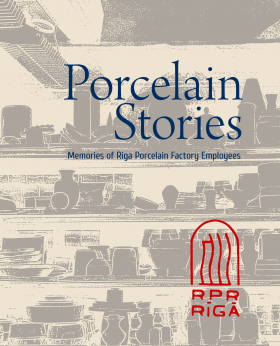 Riga Porcelain Museum publishes a book "Porcelain Stories. Memories of Riga Porcelain Factory Employees" in English.
It is an English translation of the popular book "Porcelāna stāsti. Rīgas Porcelāna rūpnīcas darbinieku atmiņas" and it's now available in the Riga Porcelain Museum.
In 2020, the Riga Porcelain Museum released the publication "Porcelain Stories". Due to public demand, the Latvian edition was reissued in early 2024. And at the end of the year, with the financial support of the State Culture Capital Foundation and Riga State City Municipality, an English translation of the publication has been prepared – "Porcelain Stories. Memories of Riga Porcelain Factory Employees".
The English edition also explores the history of Latvian porcelain art and industry and its participants, products and legacy. The oral history approach allows for direct communication of the thoughts, experiences and views of the people involved and the history of Latvian art and culture. This is particularly relevant in circumstances where authoritarian powers subjugate the culture of other peoples and usurp their narratives.
The book "Porcelain Stories [...]" contains interviews with employees and workers of the Riga Porcelain Factory (RPR). Twenty-one persons discuss their lives and daily work and give an assessment of the period from the 1940s to the 21st century. Former "porcelainists" ranging from the simplest menial worker to the enterprise director share their memories. The English version is supplemented with additional illustrative materials to give a more comprehensive picture of Latvian industrial art and especially the porcelain industry during the period under consideration. The translation from Latvian was done by Philip Birzulis, with English editing and proofreading by Jayde Will.
The publication features interviews with the following former staff members of Riga Porcelain Factory Unit 1 at 257 Latgales Street (formerly known as Maskavas Street): artists Iveta Aigare, Dace Bluma, Natālija Laminska, Aija Mūrniece, Antoņina Paškēviča and Kārlis Knopkens, Constructors' Office employee Jānis Birnis, head of the Chemistry Laboratory Tatjana Borovkova and the plant's chief technologist Natālija Molotoka, menial worker Vizbulīte Irbīte and Maija Radugina and library manager Olga Zdebska.
Today, the only reminder this gigantic factory is a chimney in the territory of the shopping mall "Akropole." But in the mid-19th century this was the cradle of the porcelain industry in Riga, the second of eight porcelain factories founded by the Kuznetsov family in the Russian Empire.
Riga Porcelain Factory Unit 2 at 3 Lēdurgas Street, which once bore the name of the Jessen family, was the second historic porcelain factory in Riga, and its former site and production buildings remain intact today. The following former employees tell us about their experiences: artists Ilga Dreiblate and Beatrise Kārkliņa, chief engineer Zigurds Konstants, master of the Technical Control Department Rasma Krastiņa, master of the Decal Workshop Skaidrīte Rosicka, modeler and later designer Āris Segliņš, master of the Capsule Workshop Marija Sorokina and head of the Porcelain Workshop Aija Strupe.
These stories tell us about the workers’ lives and achievements, and about the liquidation of the factory in the 1990s. Ulduzhan Ahmedov, director of JSC "Latelektrokeramika," reveals what happened to the buildings, people, factory and its legacy in the early 2000s.
The book is illustrated with more than two hundred images, including historical photographs, images of objects, drawings, sketches and documents from the collection and scientific archive of the Riga Porcelain Museum, the collection of the Museum of Decorative Arts and Design of the National Art Museum of Latvia, the archives of the Artists' Union of Latvia, the collection of the Information Centre of the Latvian Academy of Arts, the Latvian National Archives Latvian State Archive of Audiovisual Documents and the collections of private individuals.
The book's 280 pages present a vivid panorama of industrial life in Riga in the second half of the 20th century. It explores the controversial Soviet period and the little-known but rich industrial culture of Latvia from an individual's perspective, as well as making this legacy accessible to audiences who have been hitherto unfamiliar with it due to the language barrier.
The publication has been financially supported by the State Culture Capital Foundation and Riga State City Municipality.
The book “Porcelain Stories. Memories of Riga Porcelain Factory Employees” is available for purchase in the Riga Porcelain Museum. Mailing options are available upon request. Price of the book is 25 EUR (mailing expenses not included). During November 2025 the book is available for a discount price of 19.01 EUR.
For inquiries about the book and for purchase, please write rpm@riga.lv
-
THE UPCOMING EVENTS
The Association of Culture Institutions of Riga City Council, Pils Street 18, Riga, Latvia, LV1050, apvieniba@riga.lv
.png)